

Table of Contents
- Graphene-Enhanced Concrete
- Self-Healing Concrete
- 3D-Printed Concrete
- Bio-Based Concrete Alternatives
- Carbon-Cured Concrete
- Fiber-Reinforced Concrete
- Smart Precast Concrete
- Conclusion
Modern construction relies increasingly on advanced materials and techniques to meet growing demands for sustainability, durability, and efficiency. As the foundation of many structures, concrete has undergone significant transformations in recent years. These changes make it possible to create buildings and infrastructure that are not only stronger but also more environmentally friendly. For those interested in learning more or seeking a reputable concrete company, understanding these innovations is essential.
The latest concrete solutions emphasize minimizing environmental impact while enhancing performance characteristics, such as strength, flexibility, and longevity. This approach addresses pressing concerns about resource efficiency and climate change, shaping how we build urban landscapes and public spaces worldwide.
Many of these advancements focus not only on the material itself but also on its application and maintenance. As new techniques and materials become more prevalent, construction professionals, architects, and engineers can deliver safer, more sustainable, and cost-effective projects. With increasing regulations and community expectations, staying informed about these modern solutions is crucial for anyone involved in construction or property development.
Advanced concrete materials and methods have already shown impressive results in a variety of real-world projects. To further explore the science behind concrete and its significance in the industry, consult this helpful resource from concrete experts.
Graphene-Enhanced Concrete
Graphene, a single layer of carbon atoms arranged in a hexagonal lattice, has remarkable strength and flexibility properties. Integrating graphene into concrete mixtures has produced a material up to 30% stronger than traditional concrete. This increase in strength enables thinner concrete slabs, reducing material use and lowering emissions during construction. Additionally, graphene-enhanced concrete offers greater durability, making it ideal for high-traffic infrastructure and structures exposed to severe weather.
Self-Healing Concrete
Inspired by the ingenuity of ancient Roman builders, modern self-healing concrete uses calcium-rich compounds or specialized microorganisms to automatically seal cracks. These additives react with water and carbon dioxide when a crack forms, precipitating limestone that fills the gap. This self-sufficiency not only extends the service life of concrete structures by mitigating crack propagation but also slashes maintenance and repair costs. As urban environments age, widespread adoption of self-healing materials could significantly reduce resource consumption in infrastructure maintenance.
3D-Printed Concrete
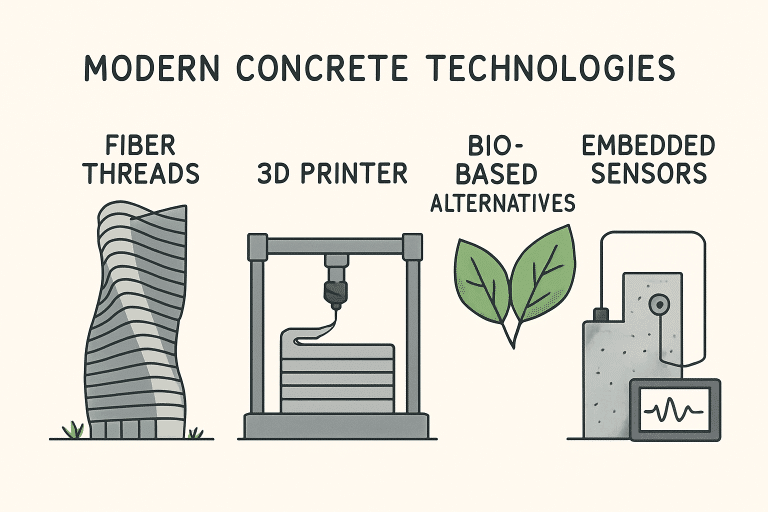
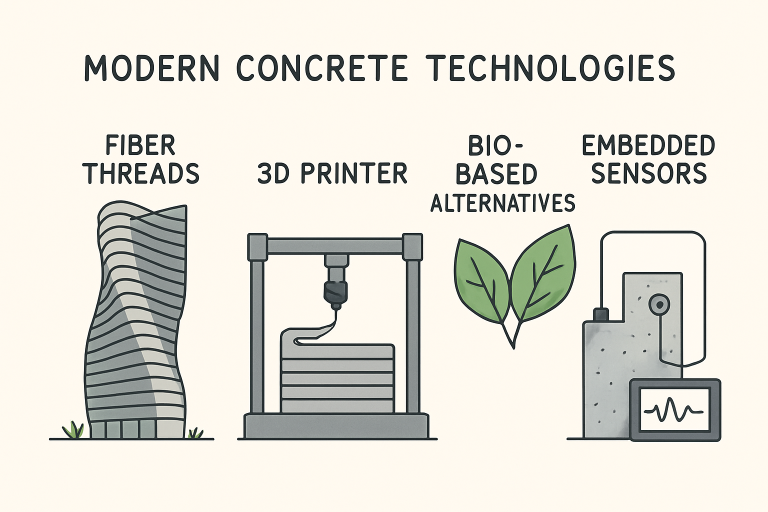
3D printing technology in construction has opened doors to new architectural designs and greater efficiency. By using computer-controlled machines to precisely deposit concrete, builders can create complex, non-linear structures that would be impossible or prohibitively expensive to form using conventional techniques. 3D-printed concrete structures are often completed faster, require fewer labor hours, and produce less material waste. Moreover, this approach enables bespoke components that meet exact specifications, accelerating customization in the building sector. The technique is gaining traction for residential, commercial, and public works projects globally.
Bio-Based Concrete Alternatives
Innovators are developing new types of concrete that use renewable, biodegradable materials. For example, “Corncrete” integrates corn and limestone derivatives, providing a more sustainable approach that reduces dependence on cement, a major source of global CO2 emissions. Other bio-based alternatives make use of industrial byproducts, plant fibers, or recycled aggregates. These materials not only reduce environmental impact but also support a circular economy, encouraging responsible sourcing and long-term ecological balance.
Carbon-Cured Concrete
Carbon-cured concrete employs a process where carbon dioxide is injected into the curing concrete mix. This triggers a chemical reaction that forms stable minerals within the concrete, permanently locking the carbon inside and reducing the material’s carbon footprint. Notably, this method can improve mechanical properties, such as compressive strength and durability. As more governments introduce carbon-reduction targets, carbon-cured concrete stands out as a promising path to meeting climate objectives in the construction sector.
Fiber-Reinforced Concrete
To address cracking and tensile weakness, manufacturers are increasingly incorporating fibers such as steel, glass, and synthetic polymers into concrete mixes. These fibers distribute loads more evenly, delaying crack formation and reducing the need for traditional reinforcement. Fiber-reinforced concrete is advantageous for industrial floors, bridge decks, and areas with heavy dynamic loads due to its enhanced resilience and reliability. It also supports creative architectural elements by enabling slender structural profiles.
Smart Precast Concrete
Deploying sensors and connectivity devices within precast concrete elements is reshaping real-time infrastructure management. Embedded smart sensors can track changes in stress, temperature, and humidity, providing engineers with valuable data. This predictive monitoring allows for timely interventions, enhances safety, and extends the lifespan of critical assets. The growing use of smart precast components is revolutionizing construction by making structures more adaptive to their environment and easier to maintain over time.
Conclusion
Innovative concrete technologies are playing a pivotal role in addressing the demands of modern construction. By integrating advanced materials like graphene and fibers, harnessing innovative methods such as 3D printing and carbon curing, and embracing sustainability with bio-based alternatives and smart systems, industry professionals are building stronger, more resilient, and environmentally conscious structures. As these advances become increasingly standard, our built environment will reflect improved sustainability and performance for generations to come.
 Sam
Sam