

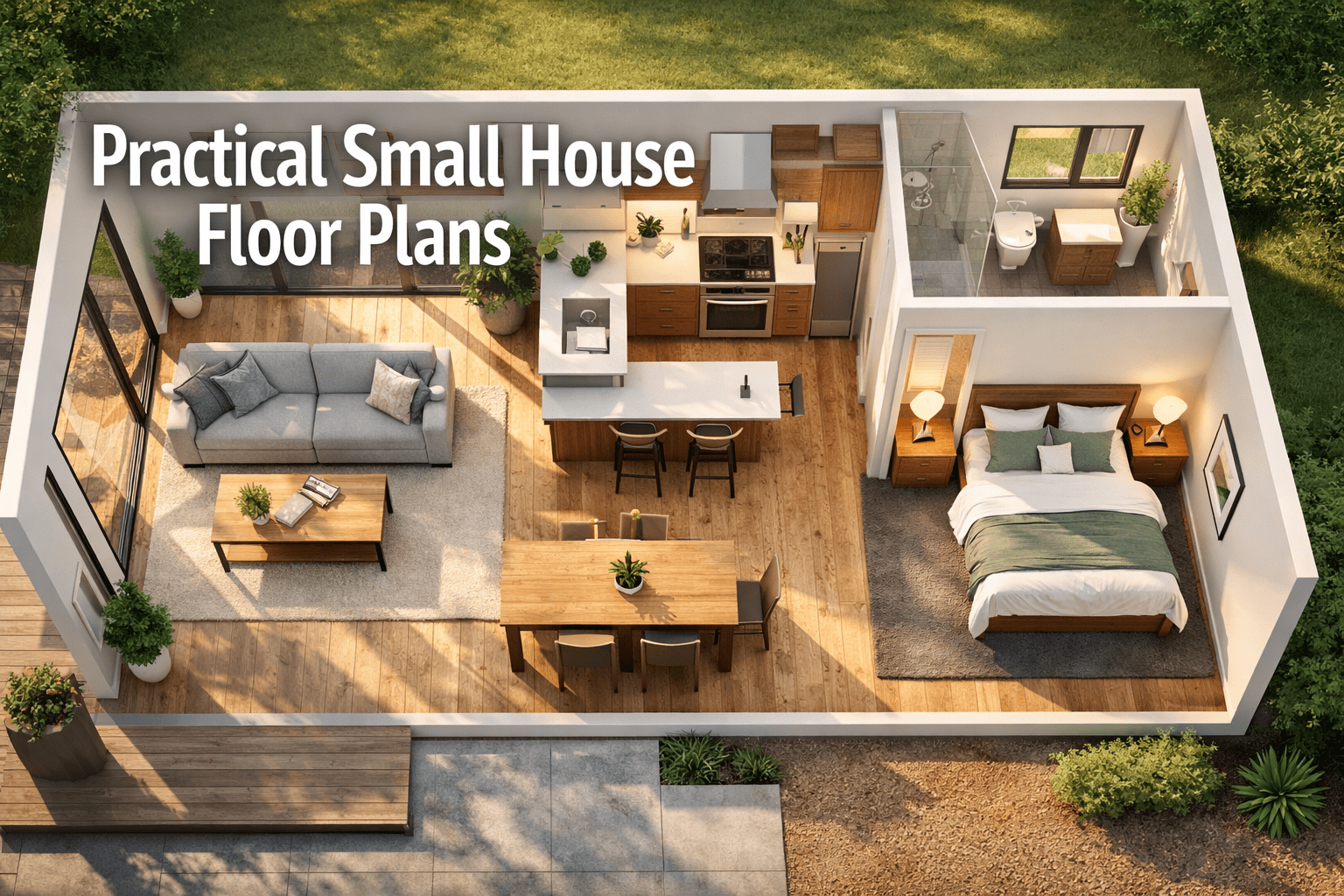
Small homes are no longer seen as a compromise. With rising construction costs, limited land availability, and a growing demand for efficient living, small house floor plans have become one of the smartest choices for modern homeowners. A well-designed small home can feel spacious, comfortable, and highly functional—often outperforming larger homes in usability and long-term value.
When planning your small house floor plan, it’s important to consider practical upgrades; check out our small home remodeling ideas for tips to optimize your space without major construction.
Table of Contents
-
What Makes a Small House Floor Plan Practical
-
Studio-Style Small House Layouts
-
One-Bedroom Open Living Floor Plans
-
Small Homes With Dedicated Home Office Space
-
Efficient Two-Bedroom Small House Plans
-
Split Bedroom Floor Plans for Privacy
-
Central Kitchen Small House Designs
-
Narrow Lot Small Home Floor Plans
-
Single-Story Small Ranch House Layouts
-
Courtyard-Based Small House Floor Plans
-
Indoor-Outdoor Small Home Layouts
-
Loft-Style Tiny House Floor Plans
-
Cabin-Style Small House Layouts
-
Backyard ADU Floor Plan Ideas
-
Flexible Small Homes for Remote Work
-
Multigenerational Small House Floor Plans
-
Common Mistakes to Avoid
-
Tips to Choose the Right Small House Layout
-
FAQs
-
People Also Ask
What Makes a Small House Floor Plan Practical?
A practical small house floor plan prioritizes function over size. Instead of unused hallways and oversized rooms, every square foot serves a purpose.
Key features of practical small home designs include:
-
Open-concept living areas
-
Minimal hallways
-
Multi-functional rooms
-
Smart storage solutions
-
Efficient plumbing and electrical layouts
-
Natural light optimization
Small homes can also be eco-friendly; our energy efficient home improvement ideas demonstrate how layouts and insulation choices reduce utility costs.
1. Studio-Style Small House Layouts (300–450 sq ft)
Studio-style layouts combine the living room, sleeping area, and kitchen into one cohesive space.
Why this floor plan works:
-
Eliminates unnecessary walls
-
Reduces construction and renovation costs
-
Easy to heat, cool, and maintain
Best uses:
-
Guest houses
-
Rental units
-
Backyard ADUs
Tip: Foldable furniture and vertical shelving maximize usable space.
2. One-Bedroom Open Living Floor Plans (500–650 sq ft)
This is a popular small house floor plan for homeowners. It separates the bedroom while keeping common areas open.
Advantages:
-
Better privacy than studio layouts
-
Ideal balance between comfort and efficiency
-
Flexible furniture arrangements
Improvement ideas: Sliding or pocket doors, built-in wardrobes, and open kitchen islands. Learn more with our kitchen layout design tips.
3. Small Homes With Dedicated Home Office Space (600–750 sq ft)
With remote work on the rise, many homeowners look for small house plans with home office.
Smart office placement options:
-
Nook near the living room
-
Converted hallway workspace
-
Partitioned corner with glass walls
Benefits include increased productivity, higher resale value, and future-proof design.
4. Efficient Two-Bedroom Small House Plans (700–850 sq ft)
Two-bedroom layouts remain highly sought after.
Why they’re practical:
-
Shared plumbing walls reduce costs
-
Ideal for families or guests
-
Easy to remodel
Bedrooms are often side by side or located at the rear for quiet and privacy.
5. Split Bedroom Floor Plans for Privacy (800–900 sq ft)
Split-bedroom layouts place bedrooms on opposite sides of the house.
Benefits:
-
Increased privacy
-
Reduced noise
-
Ideal for roommates or aging parents
These designs also support small home storage solutions for small spaces (link).
6. Central Kitchen Small House Designs (850–950 sq ft)
A central kitchen layout connects all rooms, improving workflow and social interaction.
Why homeowners prefer it:
-
Easy access to all rooms
-
Natural gathering point
-
Better lighting and ventilation
7. Narrow Lot Small Home Floor Plans (900–1,050 sq ft)
Designed for urban or city properties, narrow lot plans maximize vertical space.
Features:
-
Two-story layouts
-
Stacked plumbing
-
Rooftop or rear outdoor areas
8. Single-Story Small Ranch House Layouts (1,000–1,200 sq ft)
Ranch-style layouts remain popular due to accessibility and simplicity.
Advantages:
-
No stairs
-
Easy renovations
-
Long-term livability
9. Courtyard-Based Small House Floor Plans (900–1,100 sq ft)
Rooms arranged around a private courtyard improve ventilation, natural light, and privacy.
10. Indoor-Outdoor Small Home Layouts (850–1,050 sq ft)
L-shaped layouts extend living space to patios or decks. Ideal for entertaining and indoor-outdoor living.
11. Loft-Style Tiny House Floor Plans (300–450 sq ft)
Lofts separate sleeping areas from the main floor, saving space and increasing flexibility. Perfect for tiny homes or vacation properties.
12. Cabin-Style Small House Layouts (500–700 sq ft)
Simple, rustic layouts focus on warmth, durability, and affordability.
13. Backyard ADU Floor Plan Ideas (350–500 sq ft)
Accessory Dwelling Units (ADUs) provide rental income, guest housing, or office space.
14. Flexible Small Homes for Remote Work (800–950 sq ft)
Multi-purpose rooms adapt over time. Ideal for growing families or remote professionals.
15. Multigenerational Small House Floor Plans (950–1,100 sq ft)
Separate sleeping zones, shared living spaces, and accessibility features support extended families.
Common Mistakes to Avoid When Choosing Small House Floor Plans
1. Ignoring Storage Requirements: Use built-in cabinets, under-stair storage, and floor-to-ceiling shelving.
2. Overcrowding the Layout: Prioritize open, flexible rooms instead of forcing too many rooms in a small footprint.
3. Poor Natural Light Planning: Large windows, skylights, and glass doors make small homes feel larger.
4. Forgetting Future Needs: Plan for remote work, family growth, and aging in place.
Tips to Choose the Right Small House Layout
Before selecting a layout, consider lifestyle, budget, future expansion, and zoning regulations. For more guidance, follow our home renovation planning checklist.
FAQs About Small House Floor Plans
What is the most practical small house floor plan?
A practical small house floor plan minimizes wasted space, uses open layouts, includes smart storage, and allows rooms to serve multiple purposes.
What size is considered a small house?
Small houses typically range from 300 to 2,000 sq ft, with most efficient designs under 1,200 sq ft.
Are small house floor plans energy efficient?
Yes, small homes use less energy for heating and cooling, especially with centralized living spaces and energy-efficient windows.
People Also Ask (PAA)
Is a small house cheaper to build than a large home?
Yes, smaller homes cost less to build, maintain, and operate.
Can a small house have two bedrooms?
Absolutely. Efficient two-bedroom layouts are common for 700–1,000 sq ft homes.
What is the best layout for a narrow lot house?
Vertical layouts with open living areas and minimal hallways are ideal.
Are small houses good for resale?
Yes, well-designed small homes with modern layouts, energy efficiency, and flexible spaces often sell quickly.
 admin
admin